


Introduction: The Evolving Role of Governance
As the healthcare sector moves through 2026, organizations face a business landscape defined by risks that are nonlinear and interconnected. This complex environment demands that a board of directors evolve from a simple oversight body into a strategic asset that actively drives success. Organizations are operating in a world where risks are accelerated and volatile, often triggering sudden tipping points that can catch companies by surprise. Consequently, boards must move beyond static updates on risk and adopt dynamic views to address the volatility of the current market. The goal of a modern board is to harness collective experience to support the innovation and growth of the company rather than just monitoring compliance.
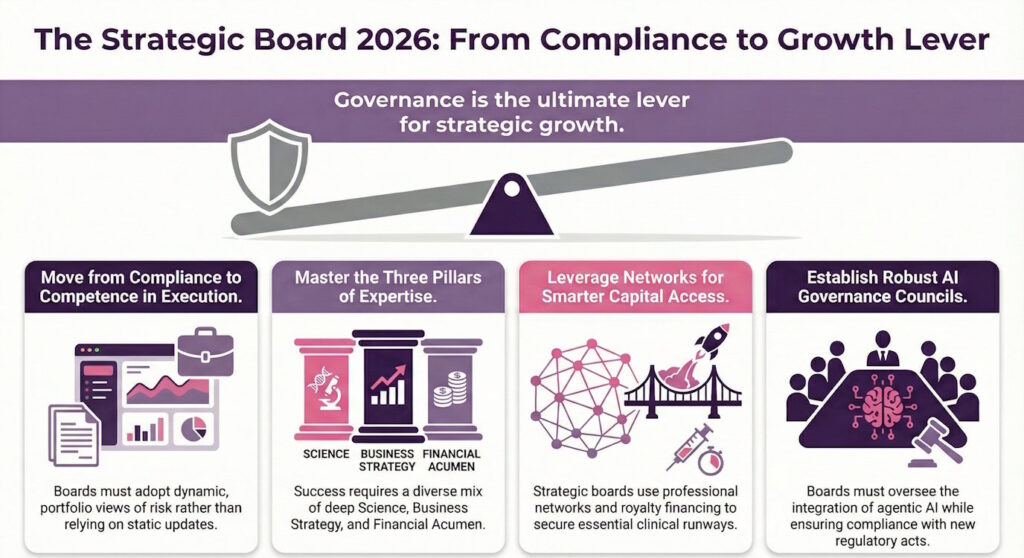
Corporate governance in 2026 requires moving from policy compliance to competence in execution. Stakeholders now expect evidence of impact rather than just intent. This shift means that governance structures must be flexible enough to enable faster decisions based on data. For instance, audit committees are expected to adopt portfolio views and scenario analysis to address risks that set off multiple downstream impacts. The traditional linear approach to risk management is no longer sufficient in a world where geopolitical and technological changes converge.
Furthermore, the board must actively bridge the gap between scientific promise and commercial reality. As the sector enters a phase defined less by promise and more by execution, leadership becomes a decisive factor in capturing market share. A board that functions as a strategic lever helps the executive team navigate the “have and have nots” dynamic of the current market, where companies with strong clinical traction thrive while others struggle. By treating governance as a foundation for strategy rather than a reactive chore, startups can build the resilience needed to survive in an unpredictable global economy.
The Three Pillars of Board Expertise
A successful board in the life sciences sector requires a diverse mix of experts across three specific domains: science, business, and finance.
- Science and Technology: Directors need deep scientific literacy to validate technical roadmaps and understand complex innovations. This includes grasping the shift toward agentic artificial intelligence where AI functions as a collaborator rather than a simple tool. Boards must oversee the deployment of these technologies, which can free up significant enterprise capacity and accelerate time to market. The integration of digital systems and artificial intelligence is now foundational, and organizations without digital capabilities risk losing competitiveness. Directors with technical backgrounds help the company pivot from pilot programs to full enterprise scale. Additionally, scientific expertise on the board is crucial for validating platforms that map genome interactions or utilize multi-omics, as these technologies reduce development timelines for complex diseases.
- Business Strategy: Experts in commercialization are essential to guide strategies for market entry. These members ensure that product launches achieve their intended effects and help the executive team navigate complex dynamics regarding market access. Business-savvy directors help companies adapt to regional differences in user preferences and tender needs. They also guide the organization in refining its value proposition to attract talent and customers in a crowded market. With the rise of consumer-driven health, boards must understand how to engage patients who expect personalized and accessible technology.
- Financial Acumen: Expertise in capital allocation remains a primary requirement for directors. Board members must understand diverse financing mechanisms ranging from royalty transactions to public market listings. Financial experts on the board guide the company through the nuances of valuation gaps and borrowing costs which remained elevated through 2025. They also help management explore alternative financing solutions, such as synthetic royalty transactions, which are increasingly used for portfolio de-risking. A board with strong financial literacy ensures that the company can balance bold investments in emerging technologies with the pragmatic ability to adapt to economic change.
Navigating the Funding Landscape via Board Networks
Securing capital for groundbreaking ideas remains a significant challenge for startups and innovators. A strategic board plays a vital role in helping companies access essential funds through their professional networks. Directors with specific experience in funding can guide management through the nuances of the deal landscape for 2026. This includes identifying non-dilutive options such as Horizon Europe which provides funding for research and innovation through 2027. Furthermore, experienced directors can help companies evaluate distinct exit pathways like initial public offerings or acquisitions by competitors.
Research indicates that the structure of the investor network significantly impacts the probability of a successful exit. Boards must understand the “Goldilocks” principle of network embeddedness: moderate levels of prior collaboration among investors maximize success, while too much familiarity can lead to groupthink and strategic complacency. A board that understands these dynamics can advise on syndicate composition, ensuring a balance between trust and fresh perspectives. This is particularly relevant for initial public offerings, which require deeper coordination than trade sales.
In the current market, capital allocation has shifted toward established platforms with clear revenue visibility. Board members with connections to private equity and corporate venture capital can facilitate these critical introductions. Corporate venture capital, in particular, can mitigate the risks of an overly insular network by injecting complementary resources and stronger monitoring. Moreover, the rise of royalty finance as a mainstream tool requires directors who can navigate these complex deal structures. Innovative deal structures now include options like step-down royalty rates and put rights, requiring sophisticated oversight. By leveraging their collective experience, the board helps the company secure the necessary runway to reach clinical milestones that drive value.
Steering Through Technical and Regulatory Revolutions
The healthcare sector is currently experiencing a revolution in technology that promises to transform patient care. Boards serve as a compass for integrating new trends such as the use of artificial intelligence in medical care and hospital administration. Governance in this era requires defining who makes decisions and on what evidence those decisions are based. The deployment of AI requires a robust governance structure, such as an AI Governance Council, which can significantly increase the likelihood of achieving return on investment. This council must have the authority to pause or retire unsafe algorithms and ensure that tiered risk controls are aligned with clinical impact.
Directors help companies adapt to updated regulations such as the AI Act in the European Union or revised guidelines for Good Clinical Practice. Regulatory bodies are moving away from surface review toward inspecting the underlying management systems that ensure ethical conduct. Compliance in 2026 resembles auditing an entire educational system rather than just grading a final exam. Therefore, the board must ensure that the organization can demonstrate rigorous compliance rather than mere documentation. This includes overseeing the implementation of shadow testing and vendor accountability frameworks to ensure safety and equity.
Independent directors play a crucial role in challenging assumptions and preventing groupthink which helps startups avoid strategic complacency. They provide the external oversight necessary to ensure that AI and digital transformation efforts are not just technological upgrades but strategic shifts that rethink how care is delivered. For instance, boards must oversee the integration of generative AI into operations, ensuring that risk management is embedded throughout the product life cycle. This oversight extends to cybersecurity, where boards must ensure that training and operational strategies evolve to address the complexities of AI-driven threats.
Harnessing Experience for Future Growth
A strategic board focuses on harnessing experience to support the innovation of the company. True commitment to environmental and social governance requires moving from simple compliance with policy to competence in execution. Founders should audit their current board composition to ensure it covers the critical pillars of science, business, and funding necessary for the market in 2026.
The convergence of strategic leadership and technological innovation is redefining the sector. Companies that prioritize leadership with deep scientific and operational expertise will be best positioned to capitalize on the next wave of therapeutic breakthroughs. However, this requires a culture where the board actively engages in intellectual sparring to foster innovation. Directors must be willing to unlearn trusted formulas for success and embrace new paradigms.
Ultimately, the board serves as the steward of the company’s long-term vision. By balancing the need for rapid technological adoption with ethical governance and robust risk management, the board ensures sustainable growth. This involves not only overseeing financial performance but also ensuring that the organization fosters trust and delivers measurable value to patients. In a world defined by interconnected risks and opportunities, a well-structured and active board is the most potent lever for navigating complexity and securing a prosperous future.
Bibliography:
- https://www.deloitte.com/us/en/insights/industry/health-care/life-sciences-and-health-care-industry-outlooks/2026-life-sciences-executive-outlook.html
- https://biopharmaapac.com/news/18/7395/26-key-trends-shaping-biotech-and-life-sciences-in-2026.html
- https://www.trinetix.com/insights/healthcare-technology-trends
- https://utopiic.com/beyond-box-ticking-what-true-esg-commitment-looks-like-in-2026/
- https://www.idealsvdr.com/blog/biotech-ma/
- https://www.mckinsey.com/industries/life-sciences/our-insights/can-european-biotechs-achieve-greater-scale-in-a-fragmented-landscape
- https://www.prnewswire.com/news-releases/deloitte-2026-life-sciences-and-health-care-outlook-industry-may-lose-billions-in-revenue-and-growth-if-consumer-mandate-isnt-met-302618182.html
- https://www.mckinsey.com/industries/life-sciences/our-insights/the-synthesis/growth-strategy-and-the-next-chapter-in-life-sciences
- https://www.bain.com/insights/topics/global-healthcare-private-equity-report/
- https://www.soci.org/news/2025/12/life-sciences-why-execs-are-cautiously-optimistic-about-2026
- https://www.healthcare.digital/single-post/medtech-2026-trends-innovation-and-strategic-imperatives
- https://www.ainvest.com/news/strategic-board-appointments-therapeutics-pipeline-expansion-biotech-enhanced-genomics-story-2601/
- https://www.excedr.com/blog/the-impact-of-board-governance-in-vc-backed-biotech-companies
- https://www.imd.org/blog/governance/advisory-board/
- https://www.bioxconomy.com/investment/reflecting-on-the-biotech-funding-landscape-of-2025-and-looking-ahead-to-2026
- https://www.gibsondunn.com/wp-content/uploads/2026/01/Life-Sciences_2026-Outlook-Brochure.pdf
- https://www.mckinsey.com/~/media/mckinsey/industries/life%20sciences/the%20synthesis%20blog/growth%20strategy%20and%20the%20next%20chapter%20in%20life%20sciences/mck250636%20life%20sciences%20compendium_full%20issue-single_v10.pdf
- https://www.thersagroup.com/wp-content/uploads/2020/05/RSA-Successful-Biotech-Boards-Talent-equity-report.pdf